
May 8th: Update from Dr. Thierfelder
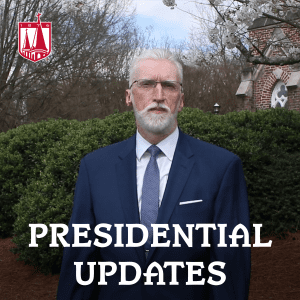
Watch the latest message from the President of Belmont Abbey College, Dr. Bill Thierfelder.
Regarding the Option for Pass/Fail
Belmont Abbey College is aware of a petition initiated by someone outside our academic community which suggests that the College give an option for pass/fail grades to our students due to the challenges we all have faced with the COVID-19 virus. This option has been evaluated by the administration including the provost and other academic officers, and we have decided the best approach is to continue our grading as planned. We know that only a small number of our students are interested in the pass/fail option but felt it worthy of addressing the issue in order to allay any concerns.
The good news is that prior to the time of the closing of the campus in March, our student’s mid-term grades were clear with known communication between faculty and students. With the subsequent transition to remote learning, we have urged our faculty to use a standard of “fairness over firmness” regarding final grades for the semester to account for the radically different way of learning. Rather than introduce further uncertainty into an already uneasy environment, and to avoid additional work for our already taxed faculty and staff, the college will not provide an option of pass/fail grades.
Moreover, a pass/fail grade could have unexpected implications on individuals regarding completion of their major field of student, potential graduate school admissions, undergraduate graduation honors, and for other awards. However, to recognize the exceptional situation facing our students and faculty this semester, the college’s official transcripts will chronicle the highly unusual pandemic circumstance by including this statement: “The COVID-19 pandemic required significant academic changes. Unusual enrollment patterns and grades received by students may reflect the disruption of their time and may be inconsistent with students’ typical performance.”
For our students and faculty, let us continue to go forward with confidence in our abilities, and embrace the challenge we have shared. We have persevered through this unexpected reality, and we know that you can complete the semester and finish strong!
We wish all our students the very best possible as we close out Spring Semester, 2020.
God Bless,

Dr. William K. Thierfelder
President of Belmont Abbey College